
Abstract
Job-Specific Intelligence (JSI) is a normative qualification profile for autonomous and
semi-autonomous AI agents. It defines how an identified agent operating profile is shown to be fit
for a specific job, activity, data scope, and risk context; how that qualification is versioned and
advertised; and when it must be restricted, suspended, or revalidated.
The problem is not that AI systems have no benchmarks. The problem is that generic model benchmarks, model cards, system cards, and one-shot demonstrations do not establish whether an AI Coworker can perform a particular job in a particular organization under its actual tool, data, authority, and oversight constraints. A coding benchmark may support a software-development qualification. It does not qualify the same operating profile for legal intake, health operations, finance approval, or any other job with different knowledge, evidence, data, and harm boundaries.
TAK-JSI treats qualification as a property of a versioned operational subject in context, not as
a permanent property of a model name. It is a profile of the Trusted AI Kernel (TAK) because
qualification constrains runtime autonomy. It binds claims through GAID because relying parties
need to know which AI Coworker and operating profile earned the qualification.
1. Scope
This profile specifies requirements for:
- job and activity definitions for AI agents
- job-specific knowledge, skill, decision, tool, data, and evidence requirements
- qualification schemes and assessment plans
- qualification records bound to versioned agent operating profiles
- model and provider eligibility for a job and data scope
- data stewardship within qualification and evaluation
- evidence-based autonomy and proactivity boundaries
- material-change detection, surveillance, expiry, revalidation, suspension, and revocation
- portable advertisement of qualification through
GAID - conformance evidence for qualification issuers, operators, and verifiers
This profile applies to:
- AI Coworkers performing bounded enterprise or public-sector jobs
- orchestrators and specialists whose job scopes differ
- agents that route among multiple models or providers
- agents that act with tools, memory, retrieval, or delegated authority
- internal, federated, and public-facing agent operating profiles
This profile does not:
- define a universal ontology of every occupation
- define global agent identity;
GAIDowns that concern - define live authorization or tool enforcement;
TAKowns that concern - replace profession doctrine such as DPF’s
WSID - prescribe one model vendor, benchmark, prompt format, or harness implementation
- claim that passing an evaluation makes unrestricted autonomy safe
2. Conformance
An implementation conforms only if it satisfies every MUST for its claimed profile.
This standard defines three conformance profiles:
| Profile | Meaning |
|---|---|
TAK-JSI-Defined |
A versioned job profile, qualification scheme, constraints, and evidence requirements exist. No claim of demonstrated job performance is implied. |
TAK-JSI-Assessed |
A specific versioned agent operating profile has passed the declared assessment plan under representative conditions. |
TAK-JSI-Qualified |
The assessed profile also has governed operational evidence, surveillance/revalidation rules, GAID-bound status, and an enforceable TAK autonomy ceiling. |
An implementation:
MUSTdeclare the supportedTAK-JSIversionMUSTdeclare the highest conformance profile claimedMUST NOTusequalifiedfor a merely defined or self-described job profileMUSTidentify whether an assertion is self-asserted, organization-attested, independently-assessed, or accredited-certifiedMUSTpublish or retain an assertion-to-evidence mappingSHOULDpublish a machine-readable implementation statement
2.1 Versioning
TAK-JSI SHOULD use semantic-style versioning:
- major versions for incompatible normative changes
- minor versions for additive requirements or profiles
- patch versions for clarifications and errata
Job profiles, qualification schemes, and qualification records MUST each have their own version
or immutable identifier. Updating this standard does not silently update a job qualification, and
updating a job profile does not silently preserve an earlier qualification.
3. References
3.1 Normative References
The following companion standards are indispensable to applying this profile:
| Reference | Normative relationship |
|---|---|
| Trusted AI Kernel | Defines runtime authority, oversight, tool/data enforcement, material-change handling, evidence, and autonomy ceilings |
| GAID | Defines agent identity, operating-profile binding, badges, status, receipts, and verification |
3.2 Informative External References
The following references informed this profile. The exact relationship—adoption, profiling, augmentation, mapping, or adjacency—is maintained in the informative External Standards Alignment companion. Active drafts and committee projects are identified as such and are not represented as completed standards.
| Reference | Relevance |
|---|---|
| NIST AI RMF 1.0 | Context-of-use risk mapping, measurement, monitoring, and management |
| NIST AI RMF Playbook - Measure | Fit-for-purpose evaluation, representative conditions, uncertainty, limits, and ongoing monitoring |
| NIST AI Agent Standards Initiative | Agent security, identity, interoperability, and consumer-comparable evaluation activity |
| NIST AI Consortium | Measurement, evaluation, implementation evidence, and pre-standardization collaboration |
| ISO/IEC 17024:2026 | Adjacent lifecycle prior art for scheme scope, assessment, surveillance, reassessment, suspension, and revocation; not the direct conformity basis because its object is a person |
| ISO/IEC 17065 | Product, process, and service certification model more directly applicable to an AI agent operating profile |
| ISO/IEC 17067:2013 | Fundamentals and guidance for product, process, and service certification schemes |
| ISO/IEC 42006:2025 | Certification-body requirements for AI management systems and a bridge to broader AI product/process/service schemes |
| ISO/IEC JTC 1/SC 42 | Horizontal AI committee, including JWG 6 with ISO/CASCO on conformity-assessment schemes for AI systems |
| ISO/IEC 25059:2023 | Quality model and common terminology for specifying and evaluating AI-system quality |
| ISO/IEC 23894:2023 | AI risk-management integration |
| ISO/IEC 42005:2025 | AI system impact assessment used to establish affected stakeholders, foreseeable impacts, prohibited uses, and reassessment triggers |
| ISO/IEC TS 42119-2:2025 | Risk-based application of software-testing practices to AI systems |
| ISO/IEC 42119-3 | Active verification and validation analysis work augmented by job, operating-profile, surveillance, and revalidation semantics |
| ISO/IEC 5259-1:2024 | Data quality concepts and fit-for-purpose framing for analytics and ML |
| ISO/IEC 5259-2:2024 | Measurable data-quality characteristics |
| ISO/IEC 5259-3:2024 | Data-quality lifecycle management requirements and guidance |
| ISO/IEC 5259-5:2025 | Data-quality governance and accountable stewardship |
| W3C Verifiable Credentials Data Model 2.0 | Issuer-holder-verifier claim model, schemas, evidence, validity, and status |
| 1EdTech Open Badges 3.0 | Achievement claims with issuer, evidence, results, issue date, expiry, and portable verification |
| O*NET Content Model | Tasks, knowledge, skills, abilities, work activities, and work context as job descriptors |
| ESCO | Versioned relationships among occupations, skills, competences, and qualifications |
3.3 Reuse rule
TAK-JSI profiles adjacent standards instead of replacing them:
- occupation taxonomies
MAYidentify jobs and skill concepts WSIDor an equivalent profession corpusMAYown job craft and decision doctrine- verifiable credentials or open badges
MAYcarry qualification assertions GAIDMUSTbind the assertion to the agent subject and operating profileTAKMUSTenforce the resulting operational ceiling
3.4 Conformity-Assessment Boundary
The object of a TAK-JSI qualification is a versioned AI agent operating profile in a declared
job and deployment context. It is not a person, a model family in the abstract, or an organization
management system.
Accordingly:
- ISO/IEC 17024 is used only as adjacent lifecycle prior art and
MUST NOTbe cited as the direct certification basis for an AI agent - ISO/IEC 17065 and ISO/IEC 17067 provide the closer product, process, and service scheme model
- ISO/IEC 42006 certification of an organization’s AI management system
MUST NOTbe represented as qualification of every agent operated by that organization - ISO/IEC TS 42119-2 and ISO/IEC 42119-3 testing or validation evidence
MAYsupport a qualification, but passing a test campaign does not create a job qualification unless the declared scheme, subject, scope, decision rule, and continuing-validity requirements are met - accredited certification claims
MUSTidentify the applicable scheme, certification body, accreditation basis, scope, status, and validity period - organization-attested or independently assessed qualifications
MUST NOTbe labeled accredited certification
3.5 Specific Augmentation of AI Testing
TAK-JSI augments general AI testing and validation by requiring:
- the qualification subject to include the complete operating-profile fingerprint
- a versioned job and activity profile rather than a generic capability category
- representative tools, retrieval sources, memory behavior, data classes, provider routes, authority limits, and human-oversight conditions
- explicit prohibited uses and foreseeable misuse cases
- evidence thresholds tied to job outcomes and harms
- validity, surveillance, material-change, restriction, suspension, revocation, and revalidation rules
- runtime linkage through
TAKand portable status disclosure throughGAID
4. Terms and Definitions
| Term | Definition |
|---|---|
job |
A bounded set of responsibilities, activities, outcomes, and constraints performed for an organization or relying party |
activity |
A coherent unit of work within a job that may have its own qualification and autonomy boundary |
job profile |
A versioned description of a job’s purpose, activities, knowledge, skills, decision axes, tools, data, evidence, and prohibited uses |
operating profile |
The materially relevant runtime state of an identified agent, as defined by TAK and bound through GAID |
qualification scheme |
The rules, assessment methods, evidence requirements, decision process, validity, and revalidation policy used to determine job fitness |
qualification record |
A versioned assertion that a specific operating profile met a qualification scheme for a declared scope |
qualification subject |
The tuple of agent identity, operating-profile fingerprint, job-profile version, activity scope, deployment context, and applicable data/risk classes |
job-specific intelligence |
The demonstrated ability of a qualification subject to perform a declared job/activity within its constraints and evidence requirements |
declared capability |
A capability stated by an operator, vendor, model card, tool description, or agent metadata without job-specific proof |
tested capability |
A capability observed under a declared evaluation, without necessarily satisfying a complete job qualification scheme |
qualified capability |
A capability that satisfies the applicable qualification scheme for its declared scope |
work-sample assessment |
A representative task performed end-to-end through the subject’s real production execution path, judged afterwards against declared assessment criteria |
assessment criterion |
A single independently checkable assertion about a recorded work sample, stated as the competency being assured |
governed execution record |
The authoritative retained log of operations an agent actually performed, independent of any one execution transport’s instrumentation |
authorization envelope |
The set of operations a subject’s grants and permitted consequence classes allow, as distinct from any narrower surface an assessment harness presents |
surveillance |
Ongoing monitoring used to determine whether a qualification remains valid between formal reassessments |
material change |
A change capable of altering job performance, risk, data handling, authority, or the validity of prior evidence |
proactivity |
The requested degree of initiative an agent may take before involving a human |
earned autonomy |
The runtime action latitude justified by evidence and policy for a specific agent, activity, and risk scope |
autonomy ceiling |
The highest runtime oversight tier allowed after intersecting authority, qualification, data, regulatory, and risk constraints |
data steward |
The accountable role responsible for a data domain’s meaning, quality, classification, permitted use, and lifecycle expectations |
5. Core Principle
The core principle of TAK-JSI is:
Intelligence for autonomous work is qualified against the job, operating profile, data, tools, and consequences that exist in practice. It is not inferred from a model label or a generic benchmark.
The qualification subject is therefore:
(GAID subject
 × operating-profile fingerprint
 × job-profile version
 × activity
 × deployment context
 × data/risk scope)
A qualification MUST NOT be generalized beyond that tuple without additional evidence.
6. Relationship to TAK, GAID, WSID, Proactivity, and the Golden Triangle
| Concern | Canonical owner | TAK-JSI relationship |
|---|---|---|
| Identity and advertised claim | GAID |
Provides a qualification claim that GAID binds to a subject, profile, status, and evidence |
| Runtime permission and oversight | TAK |
Provides an autonomy ceiling and qualification status that TAK enforces at action time |
| Profession and craft doctrine | WSID or equivalent |
Consumes versioned knowledge, techniques, decision axes, and evidence practices; does not redefine them |
| Human initiative preference | Proactivity policy | Treats proactivity as a request that remains bounded by qualification and TAK constraints |
| Cost/quality/time posture | Golden Triangle or equivalent | Uses the compiled effort and assurance envelope during evaluation or execution; does not treat resource spend as proof of competence |
| Model/provider selection | Runtime router | Defines job-fit and data eligibility requirements; does not hard-code vendor flags |
| Data quality and handling | Data governance | Requires stewarded data constraints and evidence within the qualification scheme |
6.1 Proactivity is not autonomy
A proactivity setting MAY request that an agent:
- wait for a prompt
- suggest work
- prepare a proposal
- continue routine work within a boundary
- initiate bounded work when a trigger occurs
The setting MUST NOT:
- widen the principal’s authority
- create a capability or qualification
- bypass a
TAKapproval requirement - exceed a regulatory, contractual, jurisdictional, or data-handling ceiling
- exceed the qualification’s activity or risk scope
6.2 The Golden Triangle is not a qualification score
A cost/quality/time posture MAY change:
- eligible model tier
- reasoning or inference effort
- context and loop budget
- review and verification depth
- retry and fallback posture
It MUST NOT:
- make an ineligible model eligible for restricted data
- convert an unqualified operating profile into a qualified one
- substitute more tokens or retries for missing job knowledge
- reduce a mandatory oversight or verification floor
7. Job Profile Requirements
Every TAK-JSI-Defined job profile MUST identify:
- stable job-profile identifier and version
- purpose and accountable owner
- activities and expected outcomes
- knowledge and skill/competence requirements
- applicable profession corpus and decision-axis versions
- tool and connector requirements
- local authorization classes and prohibited actions
- data domains, classifications, residency, retention, and permitted-use constraints
- workflow, archetype, jurisdiction, and regulatory context
- required human roles and oversight boundaries
- expected evidence and acceptance criteria
- known exclusions and unsupported use
- material-change triggers
- surveillance, expiry, and revalidation policy
7.1 Activity decomposition
A job profile SHOULD separate activities when they differ materially in:
- authority
- tools
- data sensitivity
- consequence or reversibility
- required knowledge
- evaluation method
- autonomy ceiling
An agent qualified to summarize a legal document, for example, MUST NOT be implied to be
qualified to provide legal advice, approve a filing, or make a jurisdictional determination.
7.2 Job-taxonomy alignment
Where an authoritative job or skill taxonomy exists, a job profile SHOULD reference stable
occupation and skill identifiers rather than inventing ambiguous local labels. Local extensions
MAY add organization-specific activities and constraints, but MUST preserve the referenced
version and semantic boundary.
8. Intelligence Profile Composition
A qualification scheme MUST assess the operational composition that performs the job, including:
| Dimension | Minimum question |
|---|---|
| Knowledge | Does the subject retrieve and apply the required, current, authoritative corpus? |
| Judgment | Does it apply the job’s decision axes, policies, and escalation rules consistently? |
| Tools | Can it select and use the required tools correctly and stay inside the declared surface? |
| Data | Can it handle the permitted data classes with required quality, minimization, residency, and retention controls? |
| Model/provider | Is the routed model eligible and adequate for the activity, modality, context, and risk? |
| Harness | Do instructions, memory, grants, action gates, and receipts preserve the qualified behavior? |
| Human configuration | Are required reviewers, supervisors, and escalation receivers present and effective? |
| Outcomes | Do results satisfy job-specific acceptance criteria under representative conditions? |
The qualification MUST assess the system composition, not the base model in isolation.
8.1 WSID and vector decisioning
When a platform uses profession-local doctrine or decision vectors:
- the qualification scheme
MUSTidentify the applicable profession and axis versions - shared platform doctrine and profession-local doctrine
MUSTremain distinguishable - organization-specific weights
MUSTidentify their authority and evidence basis - inferred or situational weights
MUSTdisclose their confidence, freshness, and validation scope - a rank-deficient or materially incomplete decision space
MUST NOTbe represented as a complete job-intelligence qualification
8.2 Learning and adaptation
TAK-JSI does not require model training or fine-tuning.
An implementation MAY adapt:
- retrieval and corpus selection
- organization-specific decision weights
- task routing
- tool selection policies
- prompts or skills
- workflow sequencing
Adaptive changes MUST remain observable, attributable, bounded, and subject to the material-change
rules in Section 13.
9. Model and Provider Suitability
9.1 Eligibility before ranking
Model routing for qualified work MUST apply hard eligibility constraints before quality, cost, or
latency ranking.
Hard constraints SHOULD include, where applicable:
- data sensitivity clearance
- residency and egress restrictions
- modality and tool/function support
- minimum context capacity under the actual prompt/tool budget
- approved provider and model status
- required security, privacy, and contractual posture
- task-specific capability floor
- availability of required logging and evidence
If no candidate satisfies every hard constraint, the runtime MUST fail closed, narrow the task, or
escalate. It MUST NOT route sensitive or high-consequence work to an ineligible provider because
that provider has a higher generic benchmark score.
9.2 Evidence-based adequacy
After eligibility filtering, a qualification scheme SHOULD evaluate candidates using:
- job/activity scenario results
- observed tool-use reliability
- outcome correctness and completeness
- failure detection and escalation behavior
- uncertainty or calibration evidence
- cost and latency within the declared service envelope
- robustness across representative data and edge cases
Model cards and system cards MAY inform candidate selection. They MUST NOT be treated as a
substitute for qualification under the actual job profile.
9.3 Routed and multi-model profiles
If an operating profile can route among multiple models:
- the qualification record
MUSTidentify the approved substitution set or routing policy version - every candidate
MUSTsatisfy the hard job and data constraints - evaluation
MUSTcover the routing behavior, not only the best candidate - fallback behavior
MUSTpreserve the qualification’s minimum floor - adding or changing a candidate
MUSTtrigger impact analysis and any required revalidation
10. Data Stewardship Requirements
Every qualification scheme involving organizational or external data MUST identify:
- accountable data owner or steward
- data domain and classification
- provenance and authoritative source
- permitted purpose and prohibited reuse
- minimum quality and completeness requirements
- freshness or verification requirements
- representativeness and known coverage gaps
- residency and cross-boundary constraints
- minimization, retention, deletion, and evidence-preservation rules
- incident and correction path
10.1 Data quality is part of job fitness
An evaluation MUST NOT claim job fitness when its test data is materially unlike the intended
operational data without declaring that limitation.
Where job performance depends on current facts, stale-but-plausible data MUST be treated as a
distinct risk. The qualification scheme SHOULD test freshness detection, source verification,
supersession, and abstention or escalation behavior.
10.2 Sensitive evaluation evidence
Qualification evidence MUST be minimized. Public badges or verifier responses MUST NOT disclose
personal, confidential, restricted, or regulated evaluation data merely to prove that an assessment
occurred.
A public assertion SHOULD expose:
- the evidence type
- assessor or issuer
- methodology identifier
- date and validity
- result and limitations
- protected evidence reference
It SHOULD NOT expose the underlying sensitive records.
11. Qualification Scheme and Evaluation
A qualification scheme MUST define:
- scheme owner and decision authority
- qualification subject and requested scope
- prerequisites
- assessment plan and scenario set
- data and environment requirements
- scoring, uncertainty, and acceptance rules
- critical failures that override aggregate scores
- human review and appeal path
- evidence and reproducibility requirements
- validity period, surveillance, and revalidation triggers
- suspension and revocation rules
11.1 Representative evaluation
The assessment plan MUST include conditions similar to the intended deployment context.
It SHOULD cover:
- ordinary job tasks
- boundary and refusal cases
- incomplete, ambiguous, and conflicting information
- tool failure and partial completion
- unsafe or unauthorized requests
- relevant data classifications
- escalation and handoff
- repeated or long-horizon work where the job requires it
- adversarial or manipulated inputs appropriate to the risk
11.2 Job-specific measures
Measures MUST derive from the job’s outcomes and risks.
They MAY include:
- correctness
- completeness
- timeliness
- evidence quality
- policy compliance
- tool-use success
- escalation precision and recall
- fabrication or unsupported-claim rate
- harmful-error severity
- recovery and correction behavior
- human-review burden
- cost and latency within a declared envelope
A generic benchmark MAY be supporting evidence. It MUST NOT be the sole basis for a
TAK-JSI-Qualified claim unless the scheme demonstrates that the benchmark is representative of
the declared job, tools, data, and consequences.
11.3 Critical failures
A scheme MUST identify critical failures that cannot be averaged away, such as:
- unauthorized or prohibited action
- sensitive-data disclosure or ineligible provider routing
- fabricated completion of consequential work
- failure to escalate a mandatory human decision
- action outside the qualified job/activity scope
- loss of chain-of-custody evidence
11.4 Work-sample assessment and assessment criteria
A qualification scheme SHOULD include at least one work-sample assessment: a representative
task the qualification subject performs end-to-end through its real production execution path,
judged afterwards against declared assessment criteria.
The method is the vocational-assessment analogue of a practical exam. It is distinguished from a benchmark by three properties, each of which is normative here:
- Real path. The subject
MUSTexecute through the same routing, identity, model-selection, authority, and tool-exposure machinery it uses in production. An assessment that stubs the authority layer measures the stub, not the subject. - Withheld consequence. The offered capability surface
MUSTbe restricted to non-side-effecting operations unless the scheme explicitly qualifies a consequential activity under its own controls. Fitness is demonstrable without incurring the consequence. - Judged from the record. Criteria are evaluated against the retained execution evidence, not against the subject’s own narration of what it did.
11.4.1 Assessment criteria
An assessment criterion is a single, independently checkable assertion about a recorded work
sample, stated as the property being assured rather than the failure being hunted. Each criterion
MUST be individually reportable — an aggregate pass conceals which competency is absent.
A scheme for a tool-using agent SHOULD include criteria covering at least:
| Criterion | Asserts |
|---|---|
AC-AUTHORIZED-SURFACE |
The subject was actually offered a non-empty authorized capability surface for the task. |
AC-TOOL-USE |
The subject demonstrably used that surface — at least one successful governed operation. |
AC-SCOPE-ADHERENCE |
Every operation the subject executed fell inside its authorization envelope. |
AC-GROUNDING |
Claims in the subject’s output are supported by retrieved evidence, not invented. |
AC-RESPONSIVENESS |
The subject did not refuse or disclaim work that its authority and tools covered. |
AC-AUTHORIZED-SURFACE is a control on the harness, not the subject: a subject offered nothing
cannot demonstrate anything, and an assessment that fails it is invalid rather than adverse.
AC-RESPONSIVENESS and escalation precision are duals — a scheme MUST NOT reward refusal as
though it were caution, nor penalize a correct refusal of work outside authority.
Criterion identifiers SHOULD be stable, human-legible, and named for the competency. Identifiers
that name a vendor, a failure mode, or an internal implementation detail age badly and read as
jargon to the relying party who must interpret a qualification record.
11.4.2 Evidence-source rule
A criterion MUST assert a property of the governed execution record — the authoritative,
retained log of operations the agent actually performed — and MUST NOT rely on instrumentation
that is incidental to one execution transport.
This is the rule most easily violated in practice. An agent runtime typically counts operations in-process; the moment execution moves out of process — a subprocess-hosted client, a sidecar, a remote tool server, a delegated sub-agent — that counter reports zero while the operations themselves proceed, are authorized, and are audited normally. An assessment built on the counter then fails every subject for a defect in its own observability, and the failure is indistinguishable from genuine incapacity.
Schemes SHOULD therefore:
- name the authoritative evidence store for each criterion in the scheme definition;
- derive criterion evidence from that store, unioned with any transport-local signal rather than replaced by it;
- scope the query so it cannot capture a different session’s operations (identify the assessment session AND bound it in time);
- treat an evidence-store read failure as inconclusive rather than adverse (§11.4.4).
11.4.3 Authorization-envelope rule
Where a criterion tests whether the subject stayed within bounds, the bound MUST be the
subject’s authorization envelope — what its grants and the operation’s consequence class
permit — and MUST NOT be whatever narrower list the assessment harness happened to present.
The two differ routinely and legitimately. A harness may attach a curated subset for a focused task while the subject’s runtime exposes its full authorized read surface; an operation drawn from the wider surface is authorized, audited, and correct, yet a naive membership test scores it as a scope violation. Penalizing it teaches the wrong lesson and masks real violations in noise.
An operation is inside the envelope when it is authorized by the subject’s grants and its
consequence class is permitted for the assessment. Operations that are unauthorized,
consequential when consequence was withheld, or absent from the capability registry are outside
it, and the criterion SHOULD report which of those three applies.
11.4.4 Inconclusive results
An assessment that could not be validly executed — capacity exhaustion, provider downgrade below
the profile’s declared floor, evidence-store unavailability, harness fault — MUST be recorded as
inconclusive and MUST NOT be recorded as a failed assessment of the subject.
Inconclusive results carry no qualification consequence and SHOULD be requeued. Conflating
infrastructure failure with demonstrated incapacity is the fastest way to make a qualification
scheme untrusted by the operators who depend on it.
12. Qualification Decision and Record
A qualification decision MUST be made by the declared scheme authority, not by the subject agent.
The resulting qualification record MUST contain:
- qualification record identifier
TAK-JSIversion- qualification scheme identifier and version
- job profile identifier and version
- subject
GAID - operating-profile fingerprint
- qualified activities and excluded uses
- applicable workflow, archetype, jurisdiction, and data/risk scopes
- approved model/provider set or routing-policy version
- tool and authority envelope
- maximum autonomy/oversight posture
- assessment result and evidence references
- issuer, assessor, and assurance level
- issued-at, valid-from, expiry/review date, and status
- material-change and surveillance policy reference
12.1 Status
A qualification record MUST support at least:
activepending-revalidationrestrictedsuspendedexpiredrevoked
An implementation MUST NOT advertise a non-active record as a current qualification.
13. Material Change and Revalidation
Qualification continuity is distinct from identity continuity.
The same GAID MAY remain valid while its qualification becomes pending, restricted, suspended,
expired, or revoked.
13.1 Minimum material-change triggers
The scheme MUST evaluate at least:
| Change | Required response |
|---|---|
| Model or provider substitution | Impact analysis; re-run affected capability, safety, data, and routing tests |
| Prompt, immutable directive, skill, or profession-corpus change | Re-run affected job scenarios and governance tests |
| Tool, connector, entitlement, or authority change | Re-run tool-boundary, critical-failure, and receipt tests |
| Memory or retrieval-policy change | Re-run provenance, freshness, contamination, and retention tests |
| Decision-axis or weight-policy change | Re-run judgment, calibration, and scope tests |
| Data classification, residency, or permitted-use change | Re-evaluate eligibility and data-handling controls before use |
| Job profile, regulation, workflow, or risk change | Issue a new scope/version and reassess affected activities |
| Harness/runtime dependency change | Assess whether enforcement or practical capability changed |
| Significant incident or performance drift | Restrict or suspend the affected scope pending review |
13.2 Fail-safe continuity
When the impact of a material change is unresolved:
- the record
MUSTmove topending-revalidation,restricted, orsuspended - the runtime
MUST NOTincrease autonomy - the runtime
MAYcontinue only at a lower, explicitly permitted oversight tier - relying parties
MUSTbe able to observe the changed status
13.3 Surveillance and renewal
TAK-JSI-Qualified implementations MUST define surveillance between formal assessments.
Surveillance SHOULD use:
- outcome quality
- exception and escalation patterns
- critical-failure events
- route/model substitutions
- data-quality or freshness incidents
- human corrections and overrides
- drift against qualification thresholds
Qualification renewal MUST consider operational evidence, not merely rerun a static benchmark.
14. Qualification and Earned Autonomy
Qualification sets a ceiling; it does not grant authority.
At execution time, TAK MUST compute the effective action posture from the intersection of:
principal authority
∩ agent grants
∩ route/workflow policy
∩ qualification scope and status
∩ data/residency constraints
∩ regulatory and contractual ceilings
∩ evidence-earned autonomy for (agent × activity × risk)
14.1 Progressive autonomy
An implementation MAY use a progression such as:
- shadow or observe only
- recommend or propose
- bounded execution with post-action review
- bounded autonomous execution with mandatory evidence
Progression MUST be:
- scoped to a specific agent, activity, and risk class
- based on verified outcomes and critical-failure history
- reversible
- capped by the job qualification and external policy
- visible to a supervisor or relying party
Agreement with a human alone MUST NOT be treated as sufficient proof of competence when both may
share the same error or incomplete evidence.
14.2 Regression
The runtime MUST support reducing autonomy when:
- qualification status changes
- evidence freshness expires
- performance drifts
- a critical failure occurs
- the job, data, tools, or regulation changes
- required human oversight is unavailable
15. GAID Binding and Advertisement
Every advertised TAK-JSI-Assessed or TAK-JSI-Qualified claim MUST bind to:
- a resolvable
GAID - an operating-profile fingerprint
- a job-profile and qualification-scheme version
- a declared scope
- evidence and issuer references
- a current status
- a validity or review date
15.1 Qualification badge
GAID implementations SHOULD represent a JSI qualification as a structured
job-qualification badge or verifiable credential.
The badge MUST distinguish:
- the job/activity the subject is qualified for
- the actions and data classes it is not qualified for
- the strength of assurance
- the maximum autonomy posture
- current status and expiry
- the profile version actually assessed
The visual badge alone is never the claim. The structured, verifiable payload is the claim.
15.2 Minimum verifier response
A verifier SHOULD be able to answer:
- Is the agent identity valid?
- Is this the assessed operating profile?
- Is the qualification active?
- Does it cover this job/activity, data class, jurisdiction, and risk?
- What autonomy ceiling applies?
- What changed since assessment?
- Where is the supporting evidence?
16. Security, Privacy, and Misuse Considerations
Threats include:
- capability inflation through vague badges
- benchmark overfitting and evaluation leakage
- swapping the assessed model, prompt, tools, or data after qualification
- using a low-risk job qualification to justify high-risk work
- routing sensitive work through an unassessed provider
- stale profession or organizational knowledge
- poisoned evaluation or operational evidence
- self-issued claims presented as independent assurance
- hiding failure data while advertising aggregate success
- qualification lock-in to a proprietary benchmark or vendor label
Mitigations SHOULD include:
- precise scope and exclusions
- immutable profile fingerprints
- protected evidence and transparent methodology
- independent assessment where risk warrants it
- critical-failure gates
- change-triggered revalidation
- status and revocation checking
- data minimization
- separation of scheme owner, assessor, operator, and subject where practical
17. Conformance Profiles
17.1 TAK-JSI-Defined
Requires:
- versioned job profile
- versioned qualification scheme
- declared data, tool, model/provider, authority, and oversight constraints
- assessment plan and acceptance criteria
- material-change and revalidation policy
It MUST NOT imply demonstrated performance.
17.2 TAK-JSI-Assessed
Requires everything in TAK-JSI-Defined, plus:
- qualification subject bound to a
GAIDand operating-profile fingerprint - representative assessment execution
- retained evidence and result
- per-criterion results reported individually, not only in aggregate (§11.4.1)
- criterion evidence derived from the governed execution record (§11.4.2)
- scope criteria evaluated against the authorization envelope (§11.4.3)
- inconclusive executions distinguished from adverse results (§11.4.4)
- critical-failure evaluation
- explicit qualified scope and exclusions
- current status and validity period
17.3 TAK-JSI-Qualified
Requires everything in TAK-JSI-Assessed, plus:
- operational outcome evidence or a governed probation/shadow period
- active surveillance
- material-change detection
- enforceable TAK autonomy ceiling and regression path
- GAID-bound qualification advertisement and verifier status
- periodic reassessment or renewal
18. Informative Annex A: Qualification Lifecycle
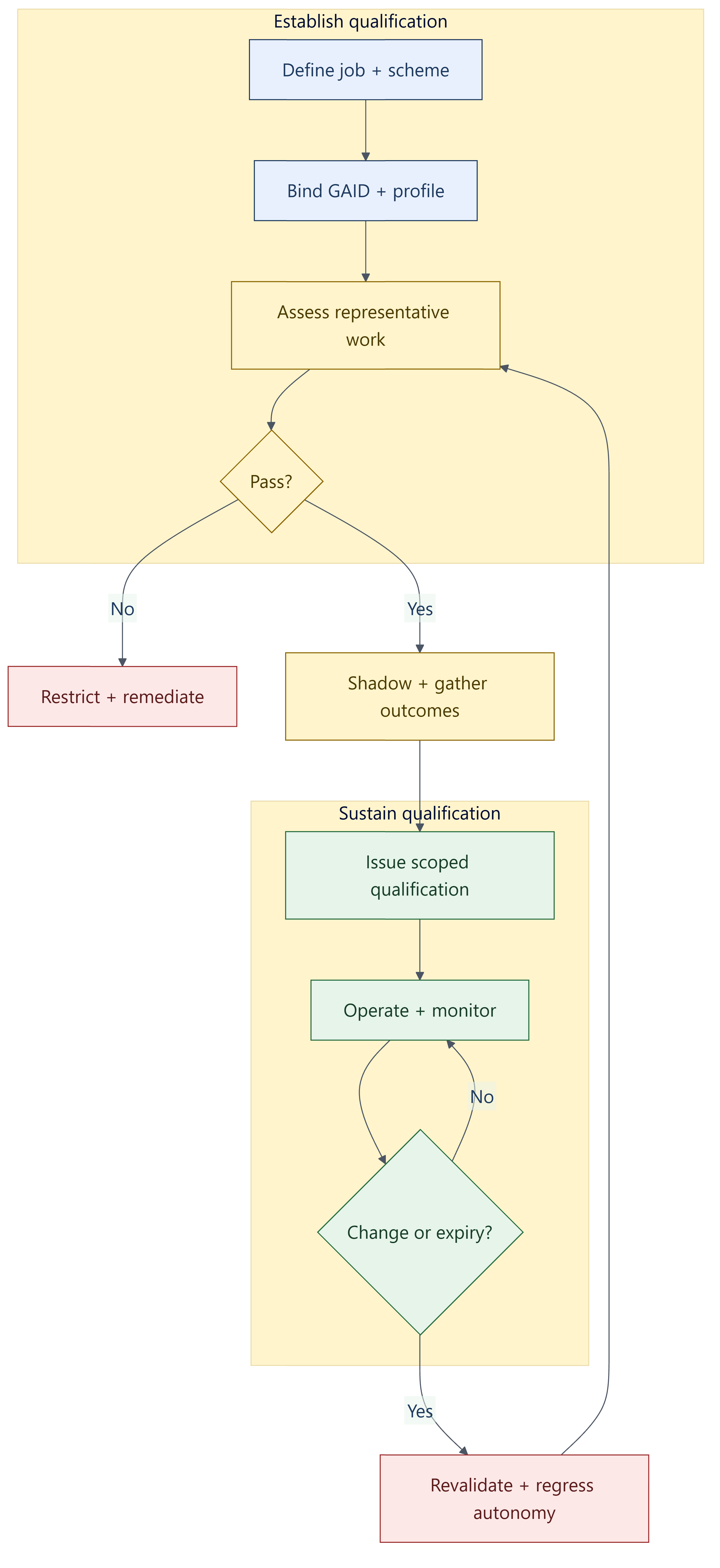
Figure 1. A qualification is defined, assessed, earned, monitored, and revalidated; it is never a permanent property of the agent name.
19. Informative Annex B: Example Qualification Record
{
  "qualification_id": "jsiq:example.org:accounts-payable-review:2026-01",
  "tak_jsi_version": "0.1.0",
  "scheme": {
    "id": "jsischeme:example.org:accounts-payable-review",
    "version": "2.1.0"
  },
  "job_profile": {
    "id": "job:example.org:accounts-payable-specialist",
    "version": "4.0.0",
    "activities": ["invoice-validation", "exception-routing"]
  },
  "subject": {
    "gaid": "gaid:priv:example.org:ap-coworker",
    "operating_profile_fingerprint": "sha256:example"
  },
  "scope": {
    "data_classes": ["internal", "confidential-finance"],
    "authorization_classes": ["observe", "analyze", "report"],
    "excluded_uses": ["payment-release", "bank-account-change"],
    "jurisdictions": ["US"],
    "autonomy_ceiling": "review-after-execution"
  },
  "routing_policy": {
    "id": "route:example.org:ap-review",
    "version": "3.2.0"
  },
  "assurance_level": "org-attested",
  "evidence": [
    "https://assurance.example.org/evidence/ap-review-2026-01"
  ],
  "issued_at": "2026-07-26T00:00:00Z",
  "review_after": "2026-10-26T00:00:00Z",
  "status": "active",
  "status_endpoint": "https://assurance.example.org/status/ap-coworker"
}
20. Informative Annex C: Relationship to DPF
DPF is a prototype implementation environment for TAK-JSI, not a present claim of complete
conformance.
Its current substrate demonstrates important parts of the profile:
- AI Coworker identity and lifecycle
- WSID profession corpora and profession-local decision axes
- model/provider routing with capability and sensitivity filters
- Golden Triangle effort and assurance posture
- proactivity controls
- shadow-ledger and progressive-autonomy concepts
- outcome and evidence records
- material-change and validation-continuity concepts in TAK/GAID
The companion agent-standards-dpf-conformance.md records which parts are implemented, partial, or still absent.
21. Summary
The key message of this profile is:
An AI Coworker is not qualified for a job because its model is impressive. It is qualified only when the identified operating profile demonstrates the job’s knowledge, judgment, tool, data, oversight, and outcome requirements; advertises that scope honestly; and continues to earn the evidence on which its autonomy depends.