
Local-LLM build engine (opencode)
Build Studio can develop the platform using the install’s own local LLM, with no
vendor credential and no token cost. This is the platform’s built-in support for
developing itself on the operator’s own hardware. The capability is delivered by a
dedicated Build Studio dispatch engine, opencode, that runs the install’s bundled
Docker Model Runner model (e.g. qwen3-coder) as a coding agent inside the sandbox.
What opencode is
opencode (sst/opencode, npm opencode-ai, pinned
to a baseline-musl build) is an open-source terminal coding agent — the same category as
Claude Code or the Codex CLI, but vendor-neutral. You point it at any OpenAI-compatible
model endpoint and run it headless:
opencode run --dir /workspace -m local/<model> --format json \
  --dangerously-skip-permissions "<prompt>"
It runs its own agent loop (read files → call the model → execute tool calls → repeat), emits structured JSON events, and edits files in place.
Why it exists
Build Studio already had three dispatch engines — claude, codex, grok — but every
one needs a vendor credential and bills tokens to a cloud API. opencode is the
local-LLM equivalent: inference goes to the install’s own endpoint (Docker Model
Runner / Ollama / vLLM), so a build runs with no credential, at zero token cost, and
air-gappable. That is what “Build Studio off the local LLM” means.
The decisive technical detail: small local models such as qwen3-coder do not reliably
do API-level tool calling, but they emit tool calls in their native <function=…>
text format. opencode parses that format itself and drives the tool loop — so the
robustness comes from opencode, not from the model’s API. This is why the build path
works on a model whose API supportsToolUse flag is false, and why the Build Studio
capability gate admits a local model only when the opencode engine is present.
How it is wired in
- Portal (
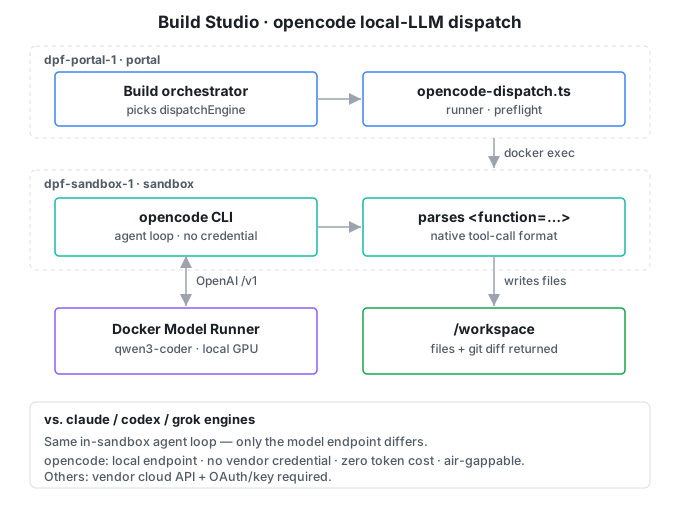
dpf-portal-1): the build orchestrator picks thedispatchEngineand hands the task toopencode-dispatch.ts— the runner that mirrorsclaude-dispatch.ts/codex-dispatch.ts. It runs a hard preflight (endpoint reachable + model present + context above an advisory floor) before spending minutes on local inference. - Sandbox (
dpf-sandbox-1): the runner doesdocker execinto the sandbox and runs the opencode CLI there — the same isolation as the other engines. A generated~/.config/opencode/opencode.jsondeclares a custom provider namedlocaland setspermission: allowso a TTY-less container never blocks. - Model: opencode calls the Docker Model Runner (e.g.
qwen3-coderon the local GPU) over the OpenAI-compatible/v1API. - Output: tool calls write into
/workspace; the--format jsonstream is parsed back into a dispatch record plus a git diff.
Install and registration
Dockerfile.sandboxinstalls the pinned opencode binary into/usr/local/binand pre-stages it under/opt/dpf-engines/opencode(the musl variant sidesteps an npm-on-Alpine install bug).packages/db/data/build-engines.jsonregisters opencode as a build engine withbakeInDefault: trueplus prestaged-binary and curl provisioning recipes — which is theBuildEngine/BuildEngineState.presentrow the capability gate checks.
Where it sits in the pipeline
A local-only install serves all five Build Studio phases:
- Ideate and Plan: pure text generation via portal-side routing
(
routeAndCall, quality-first) → the strong-tier local model; no API tool-use is required. - Build: the orchestrator dispatches the task to the opencode runner → opencode plus the local model writes the code.
- Review / Ship: the same governed gates as any other engine.
So the local LLM serves the whole pipeline; opencode is specifically the build-phase execution engine that makes code-writing robust on a small local model.
Relationship to the other engines
opencode is one of several Build Studio dispatch engines and is selected by the same auto-detection and provider configuration as the rest. The only structural difference is the model endpoint: opencode points at a local OpenAI-compatible endpoint and needs no vendor credential, whereas claude / codex / grok point at a cloud API and require OAuth or an API key. The in-sandbox agent loop, the preflight, the JSON event parsing, and the governed phase gates are shared.
Versioning note: the opencode CLI contract above is pinned to a specific release and was researched against opencode’s own documentation. Re-verify the
runflags and config schema on any version bump.